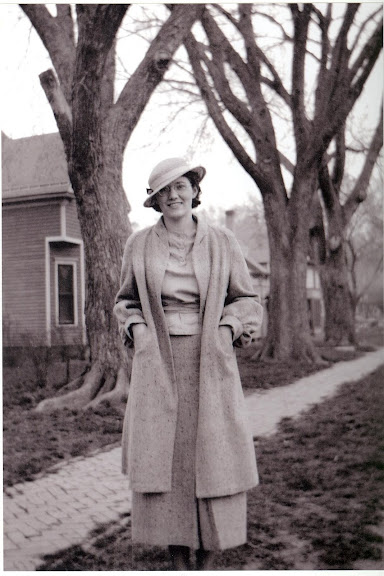
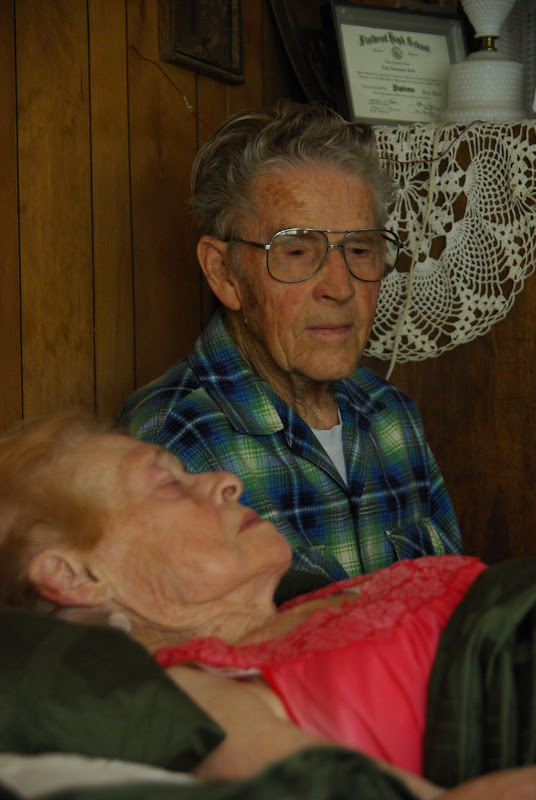
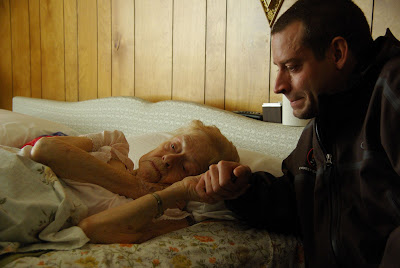
I should note that my niece Kaity took this picture below:

 I should note that my niece Kaity took this picture below:
We managed to get my grandfather out of Cascade Vista and up to Keith's place on Saturday. It might be a stretch to say that he's thriving there, but he seems to be doing well.
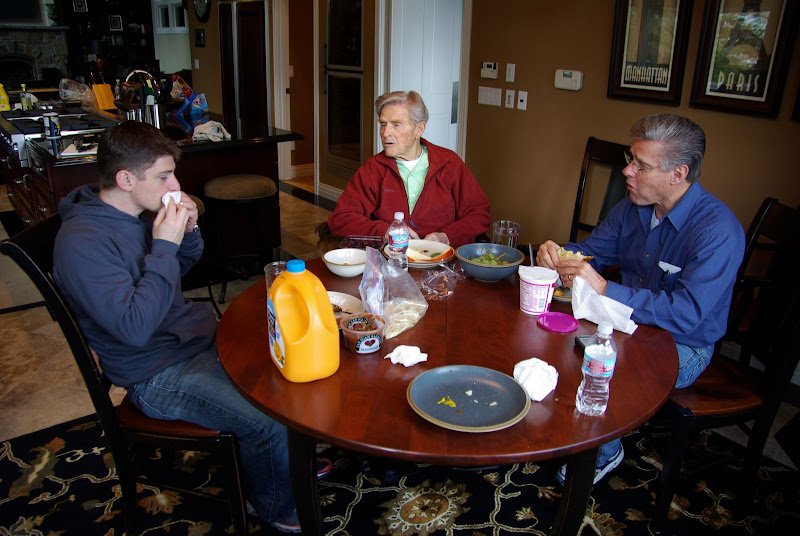
As you can imagine, a 95-year-old man with a broken ankle and a broken hip takes a fair amount of looking after. My Dad came up for an extended visit, and has been taking charge of his care for the last several days. He's heading back home today, but my cousin Amber will be up tomorrow.
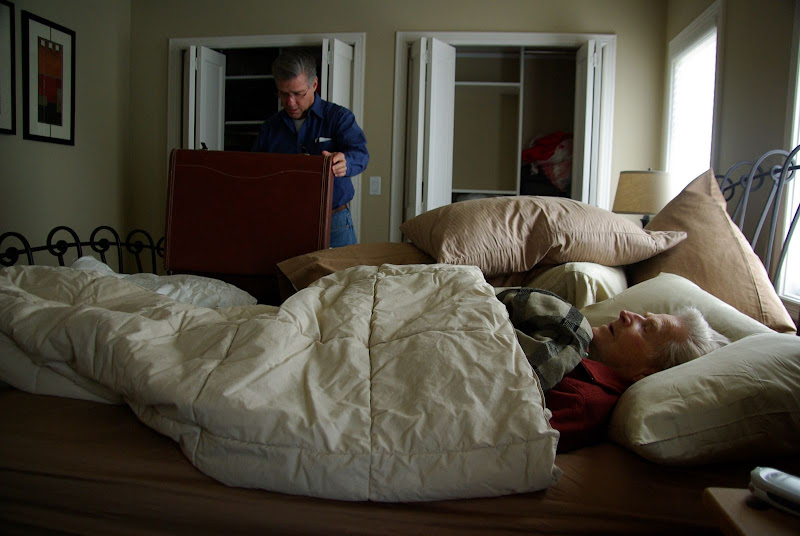
Among other things, just keeping track of his appointments and schedule is a fair bit of work. He's got a doctor's visit tomorrow to remove the staples from his hip surgery, followed by a visit with an RN to check his Coumadin levels, and then several hours of physical and occupational therapy. He's a busy guy.

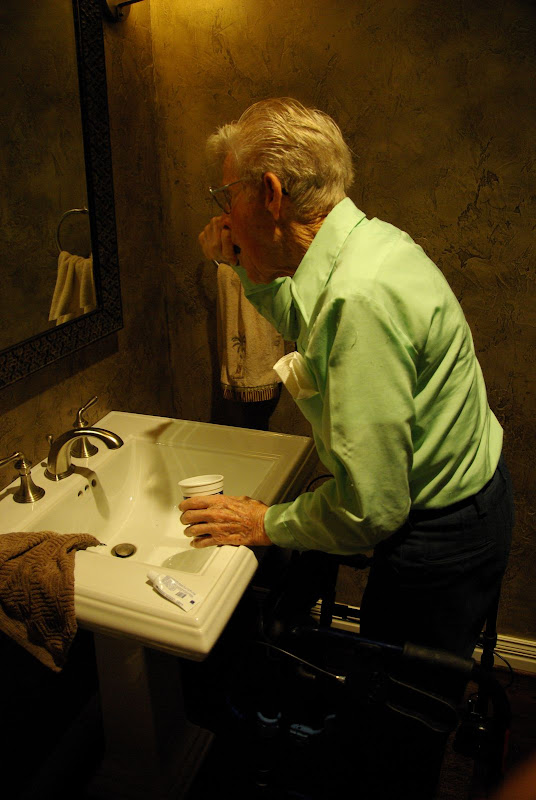
Although my grandfather's broken hip has been sad, scary and traumatic all at the same time, I have to say just a word about Evergreen Hospital. I've been in a lot of hospitals over the years, but I've never met one that has demonstrated as much a sense of customer service – or, rather, care and concern. The facilities there are astonishingly well thought-out. They've got a built-in cot in every room, and encourage family members to spend the night. The floors are hardwood, not linoleum. The doctors actually answer your questions, and several of them even ran quick errands for us. We tried to sneak my grandfather's dog into his room, only to have him joyfully greeted by the nurses. They've got not one but two espresso stands. The nurses teased and flirted with my grandfather, and came within seconds if he pressed the call button. Dr. Roh, my grandfather's surgeon, explained in a great deal of reassuring detail exactly what was going on with my grandfather's hip, and let us know that he'd be praying for him. It was an astonishing experience.
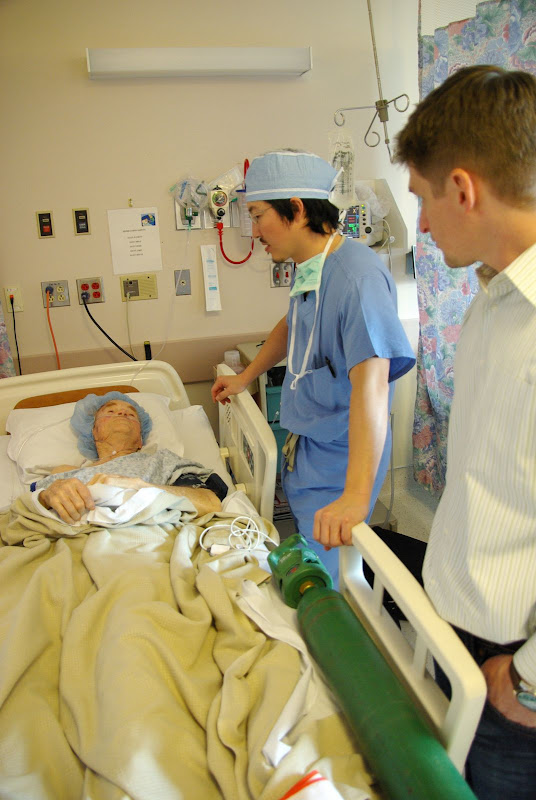
Of course, not everyone there was at the same level. Some of the staff were merely "OK", and one nurse ("Nurse Ratchett," we called her) was particularly unpleasant. She started off by chasing my brother's girlfriend out of the emergency room three times before she finally gave up and let her stay; and she followed it up by nearly wrestling my grandfather back onto his bed when he tried to help them get his shirt off by leaning forward. But she was an exception, and even though she was fully competent, her lack of customer service stood out like a sore thumb relative to nearly everyone else we encountered.
I don't recommend breaking your hip. But if you do, I recommend Evergreen Hospital.

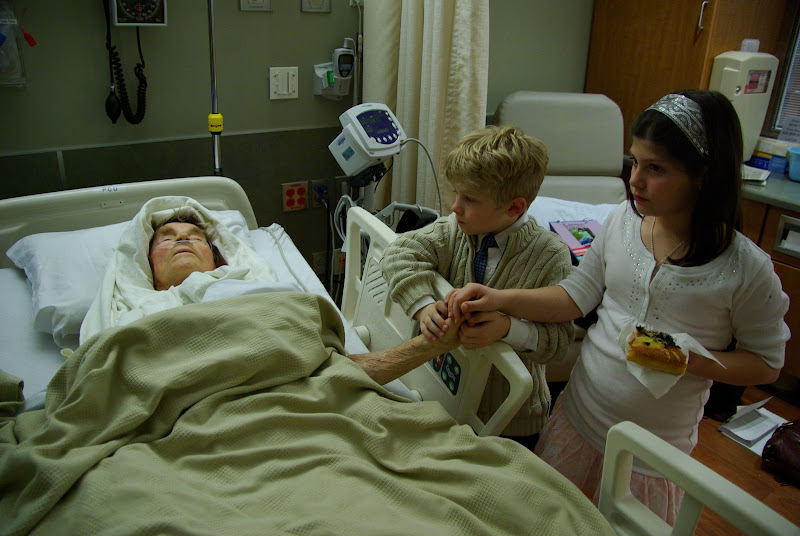
A little less than two months ago, my 95-year old grandfather lost his wife, his beloved companion of 75 years. He's continued to live independently, and family has been stopping by to see him regularly, but it's still tough for him, and I know that he's been very lonely. So Galena and I invited him up from Southern Oregon for a week or so to visit, and to have Easter dinner with family up here in Seattle. He flew in last Tuesday, and I picked him up at the airport. He was excited to see us, excited to be on his first trip in some years, and happy that someone still wanted him.
The next day, Wednesday evening, as he was going to bed, he slipped and fell down our staircase. I heard the thuds from the next room, and ran to find him lying unconscious on our hardwood floor, bleeding from a large bump on his head. I called 911. He recovered consciousness in a couple minutes, and immediately began complaining of a pain to his hip. Several hours later, in the Evergreen Hospital emergency room, an x-ray confirmed that he had broken his hip.


He had surgery the next day. Dr. Roh, a Korean Christian and, by all accounts, an excellent surgeon, repaired his hip successfully.


They've changed their approach to broken hips dramatically over the last decade or so, and the standard approach these days is to get the patient back on his feet as quickly as possible. By my count, they had him walking about 14 hours after the surgery. He was pretty sore, and fairly unsteady, but he was walking, which is more than we had expected.

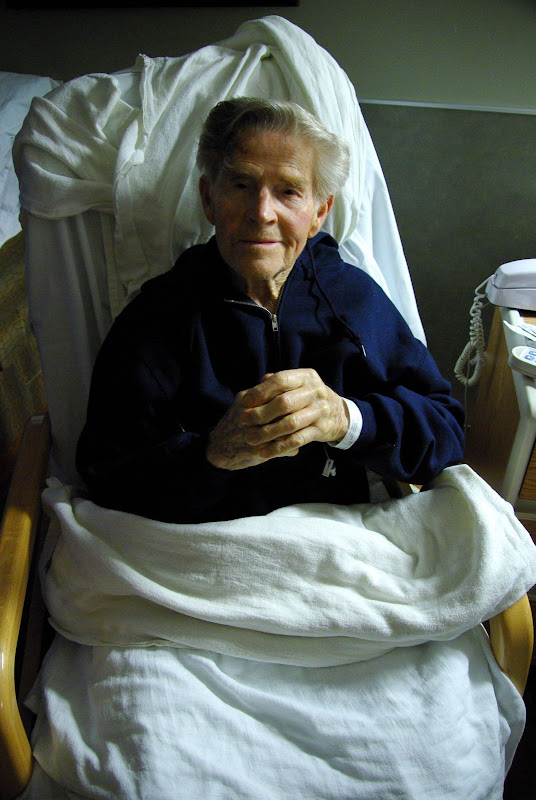
On Monday, we transferred him to a rehab center. Figuring out where he should go, and getting him there, was a fairly complicated process. I checked out all the nursing homes in the area on the Medicare "Nursing Home Compare" website, talked to half a dozen people, waffled back and forth several times, and finally selected three of the more likely rehab facilities to visit. Unfortunately, neither our first nor our second choice would take my grandfather's insurance. A word to the wise: don't ever go with an insurance plan which has bought out your "Medicare Part A" coverage. From what I can tell, the typical way they intend to be more efficient than Medicare is by throwing huge bureaucratic obstacles in the way of your accessing any of the benefits that you're entitled to. A number of nursing homes have understandably gotten tired of the run-around, and hence refuse to accept this style of insurance. It was pretty frustrating.
We finally managed to place him in Cascade Vista, a nursing home/rehab facility in Redmond, about halfway between home and office. Cascade Vista is a decent place, all things considered, but it's nevertheless been difficult for my grandfather. The quality of the staff is uneven: some of them are amazingly good and caring, some of them gruff or even rude. They had zero deficiencies in their last quality survey, which is pretty good: I checked the "skilled nursing facilities" in Grants Pass, my home town, and many were in the double-digits on that particular metric. But it's still hard for an old, blind, lame dude who has lived independently for 95 years, and on the same property for the last 60, to adjust to being stuck in bed, in a strange institution, with people who, at their best, still don't take the same care with him that his family does.
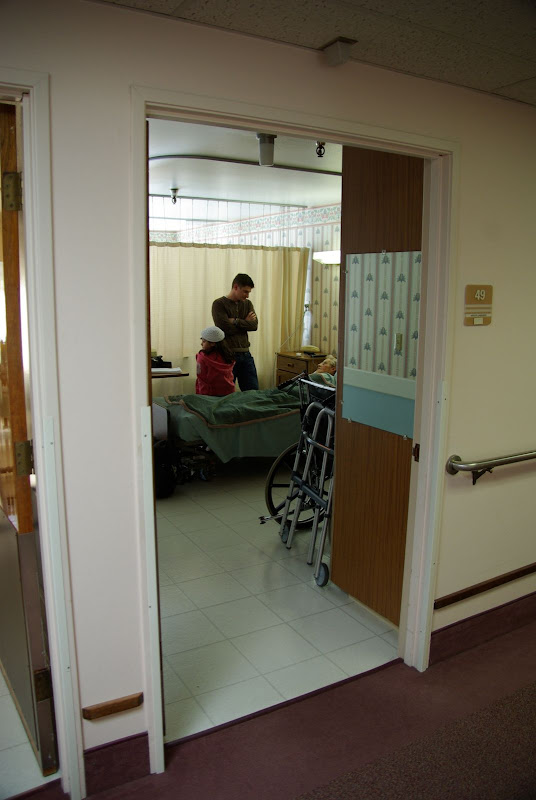
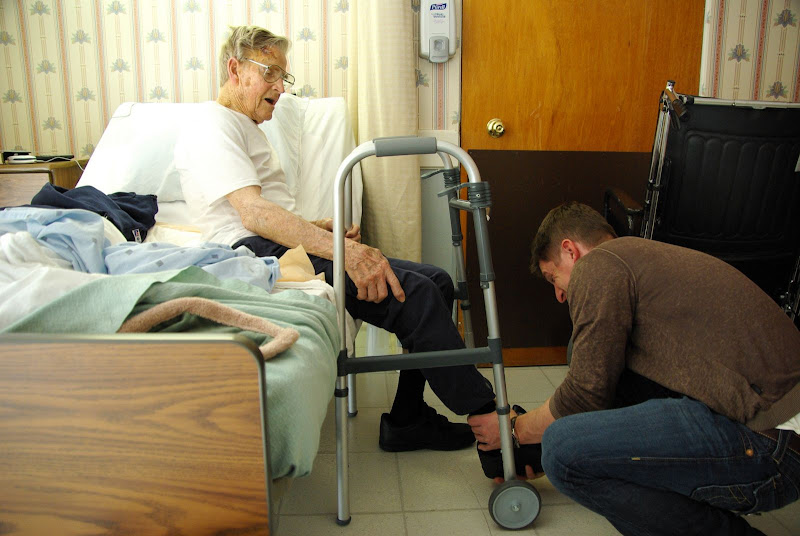
So we finally decided today that we were going to "break him out", as Keith put it. My Dad is back up, and tomorrow we'll be moving him into Keith's house. (Galena and I offered ours, but we don't have a level first floor, and the only baths and showers are on the second floor: it'll be a while before we let Grandpa navigate stairs again.) We've found a home healthcare service, and will be bringing in a physical and occupational therapist to help him regain his strength and, hopefully, his independence. I don't know that he'll ever be able to live fully independent again, and I'm pretty sure he won't be taking the stairs anytime soon. It's sad to see my grandfather, a strong, healthy, intelligent man, decline like this. But I think he still has some years in him, and hopefully he'll at least improve from where he's at now.

More pictures here.
My grandmother breathed her last at 5:00 am this morning. Until yesterday she had stayed very sharp, and relatively free from pain. Yesterday morning the pain got very strong, and as my cousin Amber worked to stay ahead of it with substantial doses of morphine, my grandmother slipped into unconsciousness. By late last night, she was breathing very slowly, down to five or six breaths a minute. My grandfather was in the room with her, and heard her stop breathing. He called Amber, then laid down beside her on the bed, with Grandma's hand in one of his, and Amber's in the other. He had been cold all night, he said, but he immediately felt warm, with the presence of God filling the room. When I showed up several hours later, he had a smile on his face, and was clearly at peace. "She's gone, and our prayers are answered. She's in the presence of Jesus, and her pain is over."
All through this slow, painful process of watching my grandmother die, I've been reminded of G. M. Hopkins' amazing poem "Felix Randall the Farrier":
FELIX RANDAL the farrier, O he is dead then? my duty all ended, Who have watched his mould of man, big-boned and hardy-handsome Pining, pining, till time when reason rambled in it and some Fatal four disorders, fleshed there, all contended? Sickness broke him. Impatient he cursed at first, but mended Being anointed and all; though a heavenlier heart began some Months earlier, since I had our sweet reprieve and ransom Tendered to him. Ah well, God rest him all road ever he offended! This seeing the sick endears them to us, us too it endears. My tongue had taught thee comfort, touch had quenched thy tears, Thy tears that touched my heart, child, Felix, poor Felix Randal; How far from then forethought of, all thy more boisterous years, When thou at the random grim forge, powerful amidst peers, Didst fettle for the great grey drayhorse his bright and battering sandal!
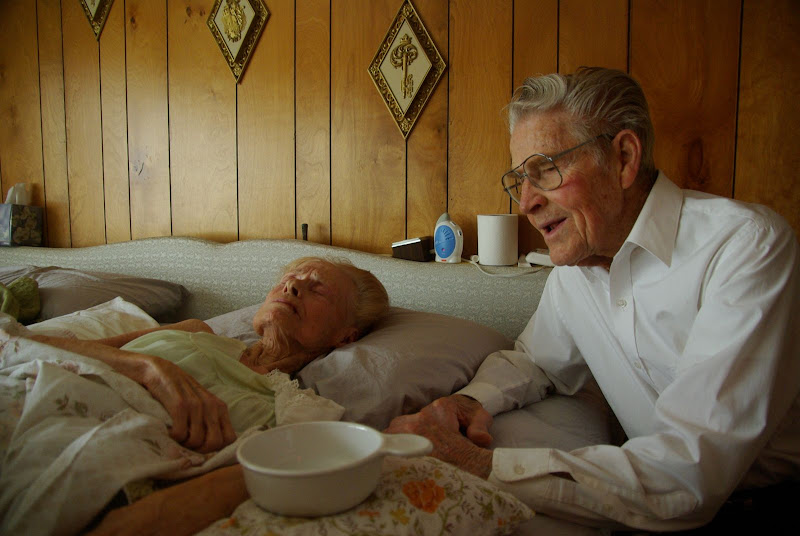

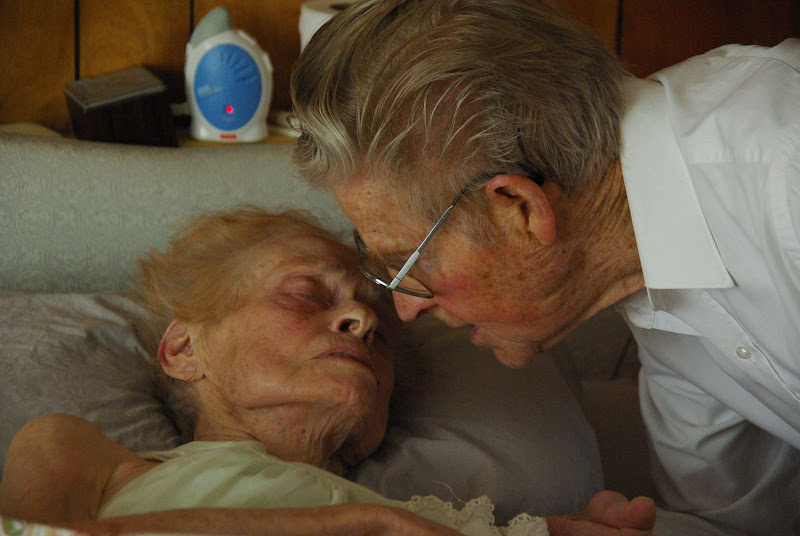
Galena, Caedmon and I are down in Southern Oregon again, with my grandparents, and assorted other relatives. My Grandma is still hanging on: weak, but in a better mood than you could expect, and still witty – at least, as witty as you can expect from a 91-year old great grandmother dying of cancer.
When we first arrived, she was bragging about my Grandpa, her spouse of 72 years. She turned to me and said, "You know, he's the best husband I ever had."
She had a hard time last night, and when I arrived this morning, she said, "Every time it hurt, it made me think of you."
"I'm still the boss," she told my Grandfather today, shaking her finger. "In a couple of days you'll be the boss, but for right now, it's still me."
"I can imagine the headline on my obituary," she said. "FINALLY."
Sometimes the conversation has revealed things we hadn't previously been aware of. "You know, the Smiths didn't have a very good reputation in Kalispell," she said yesterday. "They were really poor, and they didn't always marry the right people. When I told my Dad that I planned to marry Grandpa, he said, 'Are you sure he'll treat you well?'" Grandpa was listening, holding her hand. "When you see him," he said carefully, "tell him that I did."
After a hard night, she's been sleeping most of the day. Her breath is a bit ragged, and her pulse sometimes speeds up and sometimes slows down. And she doesn't wake up when people gather in her room and talk, or when someone takes her pulse. We could be reaching the end, but she's surprised us before.
A few minutes ago, I was standing by her bed with my grandfather, watching her chest rise and fall with her breathing. I said, "It sounds like she's breathing more slowly, but that could just be temporary." He responded, "I just wish this whole nightmare was temporary. I don't understand how I can go on from here. This is an awful kick."
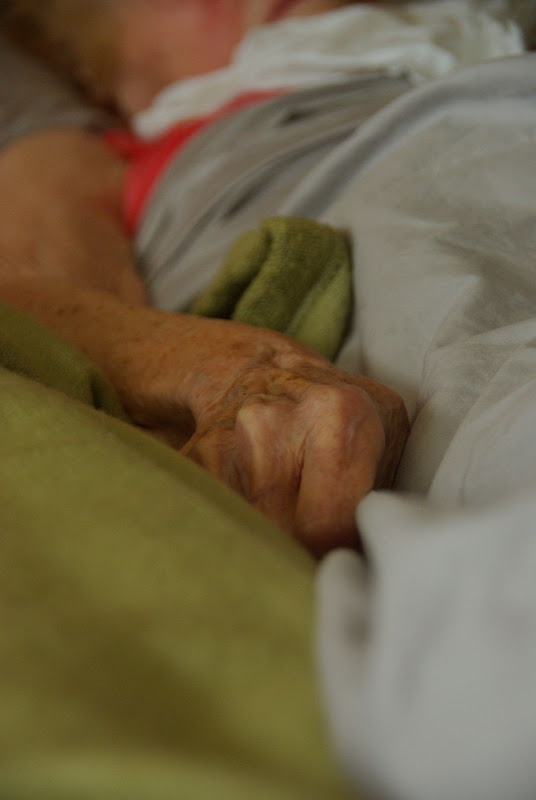
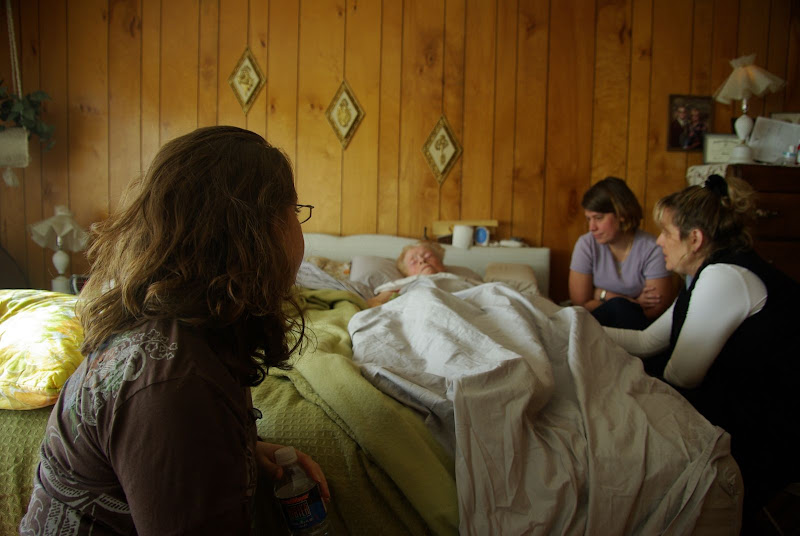
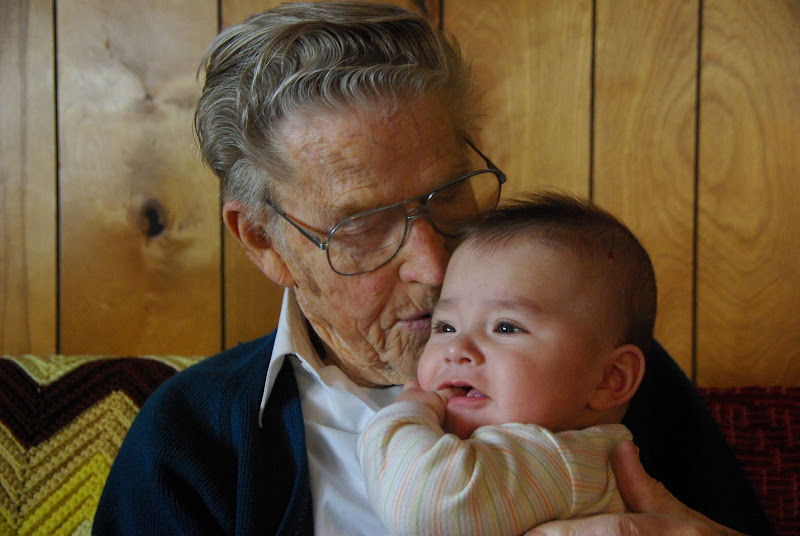
My grandmother is still hanging in there. She hasn't eaten in over two weeks, and hasn't drank anything for several days, but her body is refusing to give up. She's still surprisingly lucid, as this story from my Dad indicates:
Grandma had asked Dennis Medley (worked with her at the therapy office) to sing at her funeral in 1983 when they made their funeral plans. Dennis singing was written in their plan that I got from the funeral home folder. Dennis and Patti came by tonight to be with Mom and to talk about the funeral. We talked again about him singing He the Pearly Gates Will Open at the funeral and what they normally get paid. He told us that Mom had given him a 20 dollar bill in 1983 to pay for his singing so we do not have to pay him. He said it looks like he is on the hook to sing 25 years later. We asked Mom after he left and she said that was true. That is just like Mom, all paid up.
After spending all week down in Southern Oregon, Galena and Caedmon and I drove back home last night. My Grandma hasn't eaten for nearly a week – with the result that the cancer isn't really growing anymore, but only because she's slowly starving herself to death. She's not in a lot of pain, but it's very sad to see her so weak.
The latest update from my uncle, who's still down there, and with her every day:
It feels so strange doing family updates – Mother always did that. She is growing weaker by the day, but still talking and answering questions, and asking lots of questions.
Today she cried so much. Said her emotions were flowing.
We had another 30-40 people through the house to see her.
One sad note was watching Mother's dishes and decorative collections being distributed to family members. Mother asked us to start taking things home. I carried out some of Mother's prized red dishes to the car and bawled on the steps. It really brought home that this is it.
Lloyd was able to identify one of the folks' 1935 wedding gifts and packed it up. Mother told the story of how they got the cake stand – originally made in 1855. Each member was told if they took something, it could not end up in a garage sale.
She can still share and enjoys visiting at times, but other times she starts dreaming, she says, and talks about things that we do not understand.
She wants to get out and help us. Worries about the house.
Wants the noise to be kept down.
We had a grand church service with her last night.
Most of the family left up north for a few days of work. Lloyd is still here keeping Amber and Dad company. Amber looks so tired. Her family came over for a couple of hours to be with their mother.
The Mail Tribune came out and did a story on hospice and our family. They are doing a story on nurse shortage. Wonder how it will play out.
As Mother would have written,
Sad in Phoenix,
Larry.
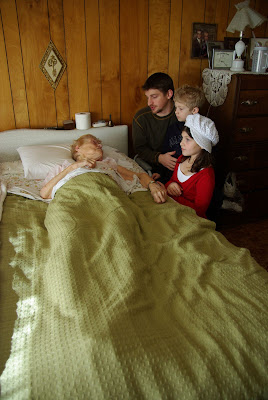
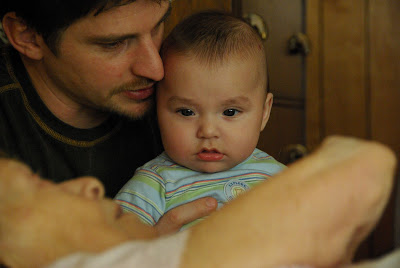
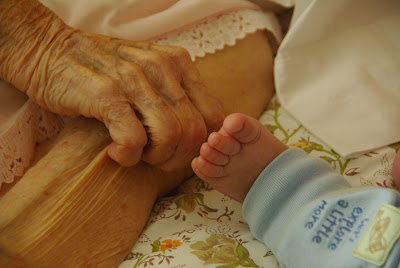
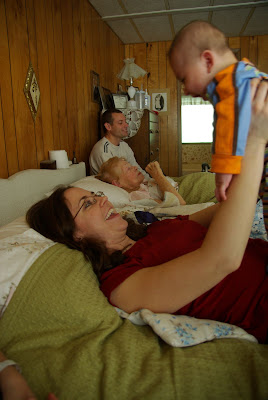
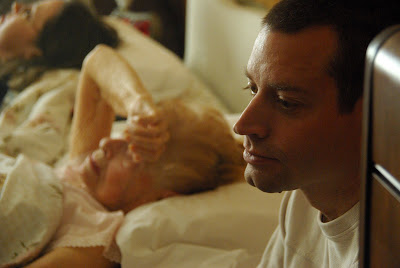
Some more pictures from our time down there:


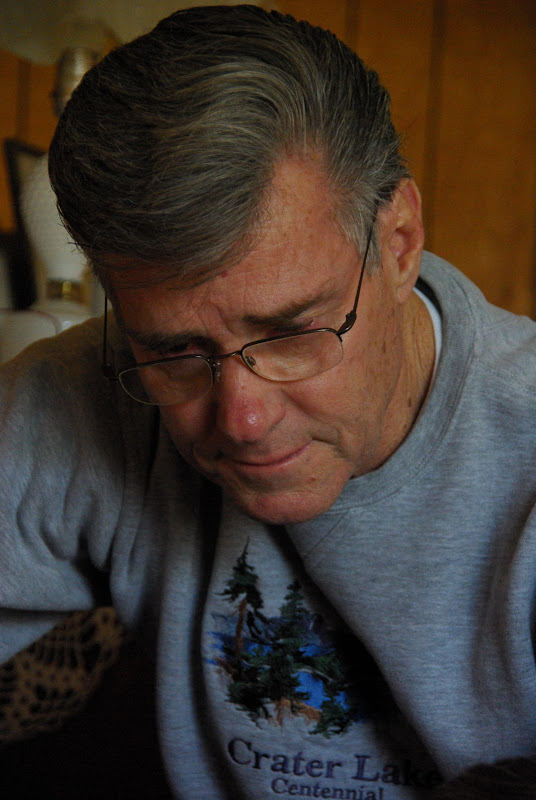
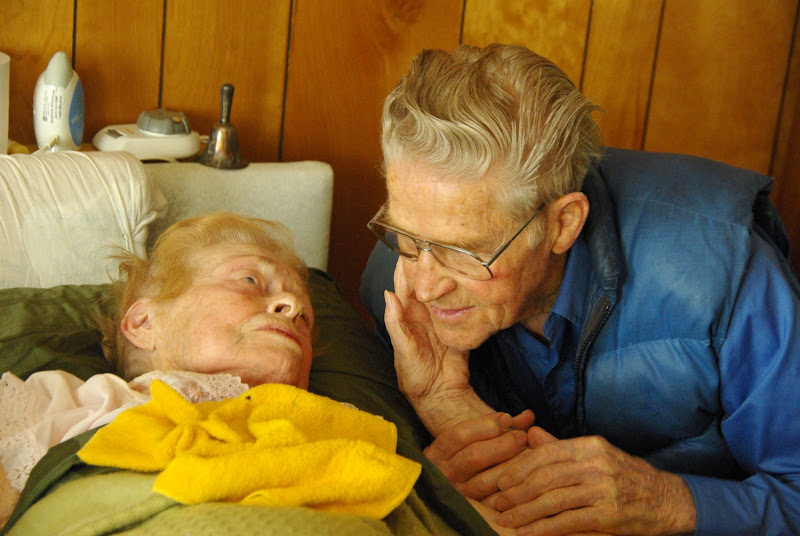



 We're waiting to hear from the oncologist, but in the meantime, the entire family is planning to descend on southern Oregon tomorrow. Please keep us in your prayers.
It’s not particularly enlightening to point out that growing older is difficult. It’s happens to everyone; and everyone complains about it. But most of the things that make being human worthwhile are the same. Everyone is born – everyone breathes – most nearly everyone has children – most people get a job – the lucky ones get a job they love. Our culture has this notion that only the exceptional is meaningful: that you’re not worth writing about unless, say, you’re climbing Mt. Everest (as my cousin is at the moment). The reality, of course, is that it’s the universal things which are most meaningful.
I first encountered this notion in Chesterton. I could go on for pages with his quotes, but I’ll let this one suffice:
“It is the one great weakness of journalism as a picture of our modern existence, that it must be a picture made up entirely of exceptions. We announce on flaring posters that a man has fallen off a scaffolding. We do not announce on flaring posters that a man has not fallen off a scaffolding. Yet this latter fact is fundamentally more exciting, as indicating that that moving tower of terror and mystery, a man, is still abroad upon the earth. That the man has not fallen off a scaffolding is really more sensational; and it is also some thousand times more common. But journalism cannot reasonably be expected thus to insist upon the permanent miracles. Busy editors cannot be expected to put on their posters, "Mr. Wilkinson Still Safe," or "Mr. Jones, of Worthing, Not Dead Yet." They cannot announce the happiness of mankind at all. They cannot describe all the forks that are not stolen, or all the marriages that are not judiciously dissolved. Hence the complex picture they give of life is of necessity fallacious; they can only represent what is unusual. However democratic they may be, they are only concerned with the minority.”
And one of those universals which is always somehow quite particular and individual is aging: growing older: getting ready for death. I’m only 38 – not really there yet – but I’ve been thinking about it a lot lately. I still have three grandparents left, but they’re aging, and watching them do so is an experience that is painful, sad, enlightening, and sometimes filled with remarkable grace.
About three months ago, my paternal grandfather (94) fell while carrying almost half his weight worth of scrap metal, and not unexpectedly, broke his ankle. In a fit of reasoning that exhibited perhaps more stubbornness than grace, he insisted that they wouldn’t have called it a “walking cast” if he hadn’t been meant to walk on it. The not-unexpected result ensued, his ankle refused to heal, and last week he had to have surgery to repair his brittle and suddenly uncooperative bones. This time the doctor’s instructions were devoid of ambiguity and left little room for interpretation.
His wife of 72 years – my 90 year old grandmother – has been doing her best to keep up with him, but we can tell that it’s wearing on her.
Following a sudden decline in her health, my 89-year old maternal grandmother recently moved into an assisted living facility. A good percentage of her 70 descendants descended onto Longview, WA, to help with the move and to get her situated in her new apartment; but then they left again, and she’s mostly alone in her apartment, too deaf to make friends, and too weak to walk anywhere but the dining room.

For a long time, I’ve felt like death is a fate to which only heroes should be subject: it’s too hard, too painful, too extraordinary to be required of ordinary people. But maybe that’s the point. It may be that death is God’s way of turning us each into heroes. In the Resurrection, not many will be able to say that they climbed Mt. Everest, or stormed the beach at Normandy, or plucked an infant from a burning building. But there will be one tragedy – and triumph – which will have ennobled us all.