Showing posts with label Israel. Show all posts

Monday, July 14, 2008

Godric

I've been working my way through The Technological Society lately, but Ellul's dour grey prose didn't seem to be the right sort of reading for a warm, blue Seattle Sunday. In addition, I was on active parent duty today, and Ellul's not the sort of author you can read very profitably if you have to put him down every few minutes to chase Caedmon away from, respectively, my dirty socks, the cat, a staircase, my laptop, a lamp and its associated electrical cord, and the toilet I accidentally left open. (I can remember, many months ago, looking forward to Caedmon's mobility.)

So I picked up Frederick Buechner's Godric instead. I've read it with pleasure and profit some three or four times previously, but it's been many years, and it seemed time to join Buechner's salty saint in damp Wear once more.

In general, Buechner runs hot and cold for me. I've never been able to make it through any of his sermon collections, and even some of his novels leave me scratching my head. Bebb is a mess, Brendan was a pale shadow of Godric, and The Storm was only, well, interesting. But periodically Buechner hits high notes that leave Italian sopranos gasping with envy. Son of Laughter ranks up with Von Rad and Alter as one of the best Genesis commentaries I've ever read, especially when you consider that it's a novel. And Godric is astonishing and delightful in every way.

I read at least one part of the novel differently this time. When Godric arrives at Jaffa, I was able to picture what the port would have looked like: I don't believe that it has much changed since Godric's time.


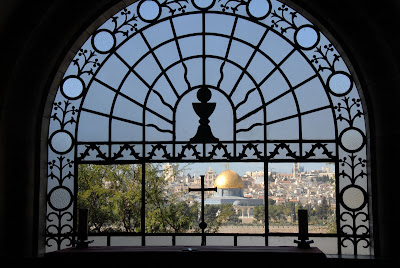
And his description of Jerusalem, for all its wrought emotion, nevertheless rings true:

"A friar with a cross led me and other palmers to the sites where thou didst cruelly suffer here on earth. At each we stopped and knelt. And every time we did, I felt thy presence near as breath. Oh wert thou near in truth, or was it only that I wished it so? The friar took us to the court where Pilate had thee flogged and showed us traces of thy blood and fingerprints upon the stone. Then didst thou hear me as I called thy name? Didst mark the tears that trickled down my beard? Oh dost thou hear and mark me now, sweet King? Old Godric has to hope that hope or else his heart, which by thy grace has thumped these hundred years, must crack at last. Amen."

I can't speak for every pilgrim, but Jerusalem evoked nearly these same emotions for me. The very air of the city was thick, uncomfortable, holy. It felt like the summit of Rainier: beautiful and majestic, oppressive and dangerous, and at home in an atmosphere that left me gasping for breath.

"When thou camest riding in upon an ass and the folk all welcomed thee with shouts of praise and palms, thou saidst if they were still, the very stones would cry aloud instead. And so they do. The streets. The walls. The earth itself. All cries. Rome and her glory were of all things dead. Jerusalem is still alive with thee."

Thursday, June 19, 2008

Benny Morris on Israel’s War of Independence

As I was leaving Ben Gurion on my latest trip to Tel Aviv, I happened across the book 1948, Benny Morris' new history of the first Arab-Israeli war. I already had too many books clogging my carry-on luggage (not to mention the shelves in my library, a fact my wife reminds me of frequently), but I couldn't help picking it up. I just finished it tonight, and I have to say, I'm impressed. Given the paucity of primary Arab source material, the book is astonishingly fair and balanced. He doesn't hesitate to criticize the Arab armies and governments for their incompetence – but neither does he shrink from laying out astonishingly detailed evidence for Israeli "ethnic cleansing" during the lead-up to the invasion and afterwards.

My first exposure to the war of 1948, and Israel's actions in that war, came from Golda Meir's autobiography. In My Life, she, well, sugarcoats the reality of what happened to a great degree. She describes – more or less accurately, I believe – a visit that she made to Haifa in 1948, specifically to encourage the Arabs from fleeing to Lebanon, and she confesses that she was greatly disappointed that they chose to flee. The impression she gives is that the Haganah would have preferred to have the Arabs stay. Benny Morris shows otherwise, in sometimes excruciating detail. Golda probably did want the Arabs of Haifa to stay. But that's only part of the reality, which elsewhere consisted of massacres of civilians (by both sides), forced evacuations (by both sides), and the razing of captured villages (by both sides).

Morris points out that while the Israelis probably committed more abuses than the Arabs, this was largely because they captured more civilian areas and won more of the battles: they had much more opportunity to do so. And Morris is also clear that whatever the Haganah's eventual practice and occasional musings by Zionist leaders, it was Arabs who officially and originally espoused "expulsionist thinking". Jewish moves towards expelling Arabs arose primarily when it became clear that the Arabs fully intended to expel the Jews (or worse), and that peaceful coexistence was unlikely. The Arab rhetoric, of course, was far more violent than the Jewish rhetoric, and the Arab practice (when it could be put into practice) was as bad or worse. And of course, it was the Arabs, against the will of the international community, who launched the war in the first place, the war which resulted in al-Nakhba, the Disaster, which has haunted the Palestinians ever since.

That said, it's still exceedingly sad to read passages like this these:

"In practice, neither side, after capturing enemy positions, houses, or traffic, kept prisoners. Captured combatants were usually shot out of hand, or less frequently, after a brief incarceration and interrogation, freed. During the first stage of the civil war, Jews probably killed more POWs than vice versa simply because Jews overran more Arab positions." (p. 153)

"As the town's HIS commander, Yitzhak Levy reported on 12 April, 'The conquest of the village was carried out with great cruelty. Whole families – women, old people, children – were killed . . . Some of the prisoners moved to places of detention, including women and children, were murdered viciously by their captors.'" (p. 127)

"At Ghabisiya,south off Kabri, the villagers – with a tradition of collaboration with the Yishuv – greeted Carmeli with white flags. But the troops opened fire, hitting several villages, and then executed six more (allegedly because of the villagers' participation in the ambush of the Yehiam Convoy two months before). The villagers were subsequently expelled." (p. 166)

"Giv'ati's Fifty-second Battalion reported sending a patrol to the fields of Sawafir, Jaladiya, and Beit 'Affa, where 'a large number of Arabs were seen reaping . . . Most … were women and old men.' The patrol killed eight Arabs and detained three." (p. 303)

In context, when you understand that Israel saw itself as fighting for its life, these actions are perhaps comprehensible. No war has ever been fought without atrocities on both sides. Certainly the US did far worse in World War 2. But it is still sad.

Sunday, June 15, 2008

Hanna Massad

I just returned last night from another trip to Israel. On this trip, I had the opportunity to travel to Bethlehem again, this time with some friends, to meet with Hanna Massad, the former pastor of the Gaza Baptist church, and his wife, Suhad, one of the directors of the Palestine Bible Society.

After a few misadventures and wrong turns, we met up Hanna Massad and his family at the Immanuel Evangelical Church in downtown Bethlehem. The service was, of course, longer and more exuberant than the Presbyterian services I've become accustomed to, but it was also shorter and less exuberant than, say, a Pentecostal service at an Indian reservation in northern Canada. The church had radio headphones available, with a simultaneous translation from Arabic to English. (And one side note: I've heard any number of times that Muslims worship Allah, while Christians worship God. But Arabic-speaking Christians also worship Allah, along with his only begotten son, Jesus Christ. "Allah", of course, is what you have to call God when you're speaking Arabic, whether you're a Muslim or a Christian.)

After the service, we did a quick tour of a few sites around Bethlehem with Hanna and his family, then had lunch at the Grotto Restaurant near Shepherd's Field. While we were there, we had a chance to get to know Hanna and his story a little bit more. He's a very impressive man: he was born in Gaza, studied at Fuller the same time I was there, became a US citizen, eventually received his Ph.D., and then moved back to Gaza to pastor the Baptist church there. A very little bit about him can be found here, here and here.

He and his family stuck it out in Gaza through death threats and bombings, but were eventually forced to flee to the West Bank last November when Rami Ayyad, a friend and one of their staff members, was kidnapped by an Islamic militant group, and was tortured and eventually executed for refusing to renounce his faith. Christianity Today has stories about it here and here.

As I said, he and his children are US citizens, and his wife holds a green card, so they could move to the US any time they want. The last time he had trouble getting out of Israel (to speak at a conference in the US), Jimmy Carter personally intervened. But despite the danger, they've decided to remain in Palestine and work for the people there. Hanna wants to get back to Gaza as soon as the situation and the Israeli bureaucracy will allow. He has suffered a great deal at the hands of Muslims, Jews and fellow Christians, but I was able to discern no anger or resentment, just sadness and a quiet courage.

Sunday, April 20, 2008

Another Fistfight at the Church of the Holy Sepulchre

This just in:
In the fight, a Greek priest was pushed to the ground and kicked, according to witnesses from both sides. Two Armenian worshippers were briefly detained by Israeli police. Scores of Armenian supporters staged a protest outside the police station during the questioning of the two, beating drums and chanting.
This is not the first time. As Jesus said, "By this shall all men know that you are my disciples, that you love one another." He was right, you know.

Saturday, April 19, 2008

Living Stones

I attended part of a conference today on peacemaking in Palestine and Israel. The conference was held at University Presbyterian Church, in downtown Seattle, and was called "Standing with the Living Stones of Palestine and Israel." It was ostensibly about supporting Palestinian Christians in the face of an increasingly hostile world, though most of it (not surprisingly) turned out to be about pressuring Israel to end the occupation of the West Bank.

That's certainly a reasonable goal. As I've written elsewhere, it's indisputable that Israel has done a piss-poor job with the West Bank. They haven't had the political courage to make up their mind about what to do with the territories captures in 1967, and as a result, they've landed themselves in a strategic nightmare. Whether it's through their roadblocks, settlements, or just plain incompetent bureaucrats, the Israeli government continues to make Palestinian daily life miserable, and all but encourages the sort of stupid, evil, suicidal violence that makes Israeli daily life tenuous.

And there was truly a great deal to admire about the general message of the conference. Sami Awad, the director of the Holy Land Trust, spoke forcefully about Christ's words to "love your enemies." "This doesn't read like a suggestion," he said. "This is a command." He went on to talk about peacemaking being the way of the courageous. "It takes far more courage to stand in front of a tank and not move, than to shoot at it and run away." It was an impressive and challenging message. Putting aside for the moment the question of whether a Christian must be a pacifist, I certainly agree that violence (whether Israeli or Palestinian) is likely to solve little in this current conflict, and that emphasis must therefore be placed on nonviolent rather than coercive solutions.

At the same time, I'm not sure that I entirely agree with the typical "nonviolent" analysis of the situation. Certainly they are largely correct in pointing out the injustice of the Israeli government's actions in settling on Palestinian land, or by making it difficult for Arabs to get building permits, or any one of dozens of other issues. But not every aspect of the Israeli government's policies can be so easily categorized.

Here's an example of what I mean. One of the conference handouts was from ICAHD, the Israeli Committee Against House Demolitions. It consisted of a side-by-side analysis of the "Israeli/Zionist/Security" and "Peace and Human Rights" framings of the situation. The "Peace and Human Rights" column included these statements:

"Israel is not fighting for its existence. The Palestinians recognize Israeli sovereignty over 78% of the country."

"Palestinian violence is a symptom of oppression."

On the one hand, it certainly is true that absent Iran developing a nuclear weapon, Israel's existence is not exactly in question at the moment; and nobody can dispute that the more Israel cracks down, the more Palestinians want to engage in violence. But on the other, you can't deny that much, if not most, of the Arab world would even now prefer Israel's defeat, if not outright destruction. Israel has fought three existential wars in her 60 year history. Hamas' charter still calls for Israel's destruction. In addition, especially since the second Intifada, suicide bombings have given Israel a great deal of cause to crack down in the territories. This graph right here, for instance, taken from Ha'Aretz, shows the ratio of successful to unsuccessful attacks.

You can argue that Israel's harsh tactics are immoral or unjust or unhelpful in the long-term; but it's difficult to dispute that they've contributed to the growth of the yellow bars and the decrease in the size of the red ones.

But although I don't agree entirely with the narrative offered by the nonviolence movement, I don't fully agree with any other narrative I've heard either. I think the overall situation, when it comes right down to it, is too complex to be easily captured in any "narrative". You can only talk about individual situations and actions, and try to place the actions of each side in as broad a context as possible, before offering a judgment about the morality of a given situation or action.

This is why I'm not quite comfortable with the peacemaking movement as currently constituted: it fails to recognize that the actions of the poor and weak can be just as evil as the actions of the strong and victorious. I admire anyone who stands in front of tanks and denounces the IDF, but I would trust their analysis of the situation more if I knew that they also stood in front of rocket launching crews and denounced Hamas. Perhaps they do – but I've never seen it advertised.

I do think that it's helpful to outline the different narratives the warring parties tell themselves. But the most helpful approach is to assess the relative truth of the different narratives as they apply to individual situations, and to correct them impartially when they don't appear to be accurate. As a famous Jew once said, "You shall know the truth, and the truth shall set you free." A careful and objective analysis doesn't make for good soundbites, but it has other qualities which perhaps make up for this.

In this light, to my mind the most interesting speaker at the conference was Hank Landau, the now-retired founder of Landau Associates. He seemed to have very little interest in ideology or who was right and who was wrong. He just wanted people (whether Israeli or Palestinian) to have clean water, and he was willing to work with anybody who could help that happen. His talk on the geography and climate of Israel and Palestine was refreshing: just the facts, only as much judgment as was minimally required, and for that reason, oddly and surprisingly hopeful.

Thursday, March 13, 2008

Thoughts on the West Bank

A week and a half ago, I spent two days in the West Bank, visiting Bethlehem, Jericho and Hebron. After some hesitation, I've decided to write up some of my thoughts and observations about what I observed. It's a complex situation, and after having done a fair bit of reading on the topic, I'm well aware that any attempt to make sense of the more than 60 years of bloodshed between the Israelis and the Palestinians – the Jews and the Arabs – will fail to do the situation justice. But I thought I'd add some opinions to the mix. Please take them as my limited attempt to understand a complex situation, not as the final word on any of the issues I touch on.

My Starting Point

I'm a friend of Israel. I get chills down my spine when I think about how Israel has managed to survive in the face of so many well-armed enemies. Its struggle for independence, and its war against the six Arab armies which attacked on the first day of its existence; and its stunning victory in the Six Day War; and the astonishing way in which it snatched victory from the jaws of defeat in the Yom Kippur War; in each of these stories, my emotional loyalties lie entirely on the side of Israel. My visits to Israel over the last two years have given me a great deal of respect for what Israel has managed to create, and to become.

The Settlements

I'm convinced that Israel's decision to build settlements in the West Bank is the single worst strategic blunder that Israel has made since 1948.

In the wake of the Six Day War in 1967, like a dog who couldn't figure out what to do with the car it had finally caught, Israel was at a loss with the territories it had just captured. Israel eventually annexed the culturally significant East Jerusalem and the strategically significant Golan Heights, but it couldn't do so for the West Bank or the Gaza strip, as it would have required granting civil rights to their populace. Nor could it find an acceptable formula by which to return them, respectively, to Jordon and Egypt; or alternatively to grant them independence and self-rule. (Some, though not all of this, was the Palestinians' fault, who "never lost an opportunity to lose an opportunity.") Lacking a long-term strategy, Israel at first reluctantly allowed, and eventually encouraged, the construction of settlements in the territory it had captured. In the face of numerous UN Security Council resolutions, both Labor and Likud governments adopted this policy. It kept the far right reasonably happy, and it solved numerous short-term political problems for the succession of prime ministers.

Unfortunately, this policy has also created a long-term strategic nightmare for Israel. Now that hundreds of thousands of Israelis live in territory that is (quite reasonably) claimed by the Palestinians, Israel has no good alternatives available. It can't annex the territories, as the influx of Arab voters would quickly turn Israeli Jews into a minority. It can't give the Palestinians all the territory they rightly deserve, as there are now Israelis living on much of it. And it can't adopt a peaceful, two-state solution, as the Palestinians won't sign a peace deal until they get their land back.

Yes, yes, it's more complicated than this, I know. In 2000, Ehud Barak courageously offered to give the Palestinians nearly all of their land back – with some significant caveats – and Arafat stupidly turned him down. But Arafat was an idiot, and while Mahmoud Abbas is a weak leader of a corrupt government, I don't think he's an idiot. There's a small chance that Israel could reach a peace deal with him. And so long as Israel continues to build more settlements, they're making any conceivable peace deal more complicated, painful and unlikely. I understand why the Palestinians stew each time they see another hilltop settlement erected. What I don't understand is why the Israeli government keeps allowing it. Even from the perspective of Israel's own self-interest, it's an astonishingly bone-headed move.

The Occupation

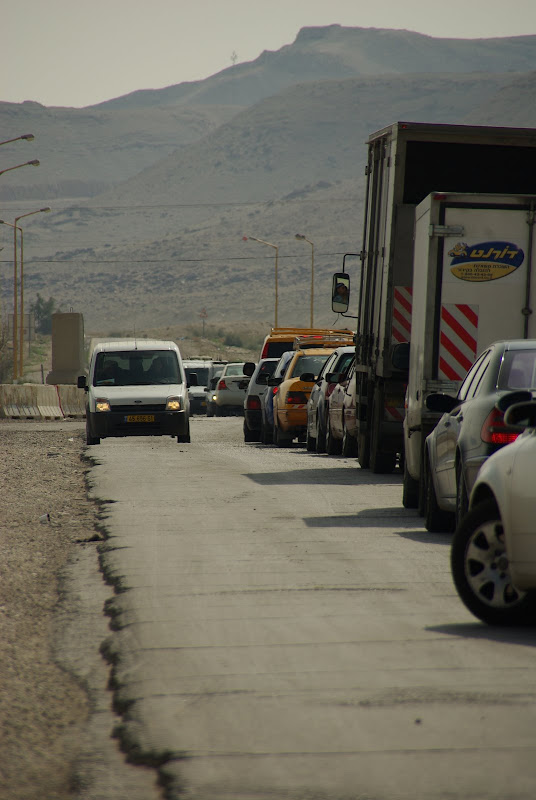
As a result of two Intifadas, and more than a hundred suicide bombings, Israel has cracked down hard on life in the West Bank. Having visited there even briefly, I can understand the frustration that the Palestinians feel with the Israeli occupation. They have little control over their destinies, their livelihoods, their travel, indeed, even when and where they can find gasoline for their cars. Israeli roadblocks and checkpoints are everywhere, and a trip that should take minutes can turn into an hours-long lesson in patience and submission if an 18-year old Israeli soldier is in a bad mood. (And what soldier, or indeed, what 18-year old isn't?)
The IDF is a highly disciplined and effective force, but they are rarely gentle or subtle. Less than a month ago, my guide's home was taken over by a squad of Israeli soldiers intent on capturing a militant living in a nearby house. My guide and his terrified family were locked into a cold room for seven hours while a firefight raged on their roof. The Israeli soldiers caused several thousand dollars of unreimbursed damage to my guide's home. And after the militant had been captured, Israeli bulldozers destroyed the small apartment building where his family (and three others) had lived.
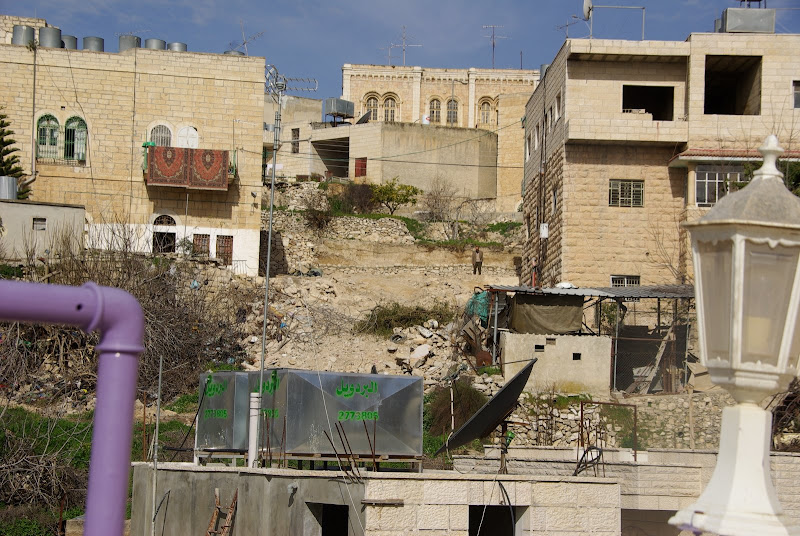
Last Thursday, the IDF captured another militant nearby, and destroyed another four-family dwelling. Destroying property, even a family home, is of course at a different moral level than intentionally killing innocent civilians. But as G. K. Chesterton said long ago, "To have the right to do something is not the same as to be right in doing it."

The Wall

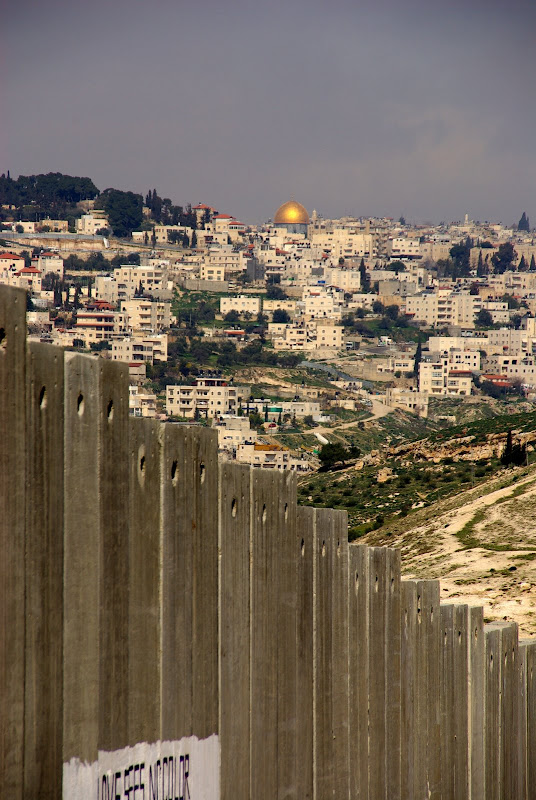
As most folks know, Israel is building a wall (sometimes termed a "fence") between the West Bank and the vast bulk of Israeli citizens. I phrased that sentence carefully: the Wall (it deserves the capital letter) is not so much between Palestine and Israel, but rather, between Palestinians and Israelis, wherever they're located.

Having now visited the West Bank, I have a slightly different perspective on the Wall than I used to. I fully support Israel's right to protect itself from suicide bombers, and a wall is a reasonable, if not an entirely gentle way of accomplishing that goal. But the way that the Wall is actually being built is unnecessarily and foolishly harsh – and indeed, gives some real degree of credence to Palestinian claims that the purpose of the Wall is less to protect Israeli citizens and more to establish a de facto, unilateral border.
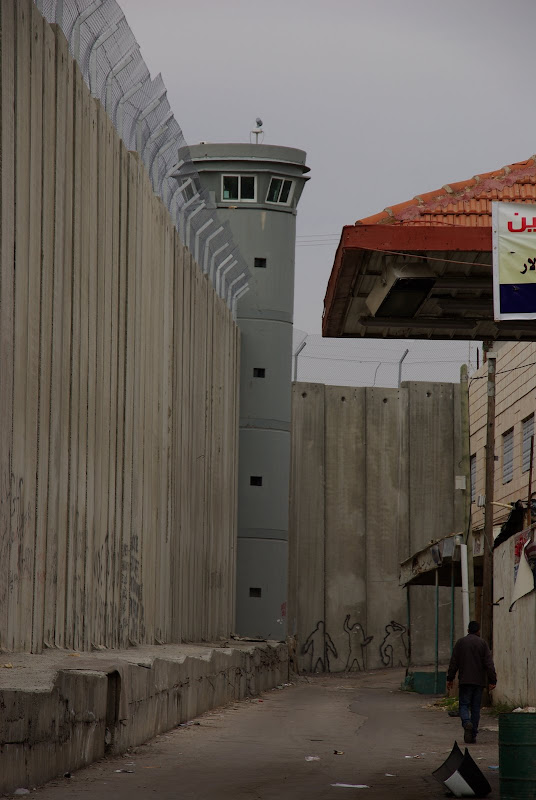
And like most decisions made unilaterally, it seems to be entirely one-sided, in Israel's favor. I saw numerous examples of Palestinian farmers clearly cut off from their land, and for no purpose. The Wall could easily have followed a route which allowed the farmers to continue accessing their territory, while fully providing for Israeli security. When you look at situations like that, the Palestinian side becomes a bit more believable. In nearly every instance I saw, the Wall established maximalist Israeli claims, far exceeding Israel's 1967 borders, and dramatically impeding daily life for Palestinians.
The Palestinian People

I confess that I find the Palestinians to be a mystery. Every Arab I met in my visit, whether on the Israeli or the Palestinian side of the line, was unfailingly kind, generous, and friendly. Arabs are famous for their hospitality, and I saw much to confirm and nothing to contradict this.

At the same time, I believe that the Palestinian public has badly failed the difficult moral test to which they have been subjected. One of the many ways that the Palestinians have contributed to the untenable situation in which they now find themselves is by allowing, encouraging, and even celebrating the intentional murder of innocent Israeli citizens. Their cities are filled with posters celebrating suicide bombers. I was astonished to hear even Christian Palestinians refer to suicide bombers as "martyrs". I was unable to discern any sympathy for Israeli citizens killed in terrorist attacks. Conversely, nearly all of my Israeli friends express remorse for Palestinian casualties, even if they're unable to understand the Palestinians' frustration.

In particular it was sad to me how even the Palestinian Christians I met were unable to see any part of the Israeli side. Over my two days there, I had some reasonably frank conversations with my guide about the situation. Some of his opinions surprised me: for instance, he has no desire for a two-state solution, detests both Fatah and Hamas, and really wants to go back to being occupied by Israel (in the way the occupation was conducted prior to the first Intifada). But some of his opinions surprised me in the other direction. He had no recognition that the reason life was so difficult for the Palestinians was because of the suicide bombings. His perception of the situation was entirely on the other side. During my visit, we heard that 35 Gazans (about half of them civilians) had been killed in an Israeli air strike. My guide was furious, and said, "Can you blame them for launching rockets?" The fact that Israel wouldn't have been launching these attacks against Hamas militants if Hamas hadn't been firing rockets into civilians' homes entirely failed to register with him. You can argue that Israel's response was disproportionate – but you can't argue that Israel wasn't sorely provoked. (If Mexico had been launching rockets into San Diego, you can bet that we'd respond, and with fairly good justification.) And whether Israel's air strikes fall into the category of "just war" or not (I think you can make a reasonable case either way), there's clearly a moral distinction between trying to kill civilians, on the one hand; and trying to kill militants, and accidentally killing civilians, on the other.

The Rockets

Along these lines, it's hard to miss the recent escalation in violence between the Israelis and the Palestinians. Most of it is in the Gaza strip, along the Mediterranean, where, the historically minded might note, the Philistines used to live. The radical groups in Gaza have been launching homemade Qassam rockets at small Israeli towns near the Gaza border for several years now; but they've recently managed to acquire some Iranian-made Katyusha rockets that have a longer range, and they've been launching these at Ashkelon (one of the old Philistine cities, but now a major Israeli urban center).

One of many interesting things about this is that I have several Israeli friends who live in Ashkelon and commute to work in Tel Aviv, and I know many others who have family and relatives there. I met one friend on her way into work, and she said, "Well, a Katyusha rocket landed next to my house this morning as I was leaving." Nobody was hurt (in that particular attack), but it's still odd having friends who can only get to work through a hail of rockets. It certainly makes the traffic on my commute from Woodinville to Bellevue a bit less distressing.

Two Wars

The best explanation I've heard about what's going on there is what an Israeli friend mentioned the other day. He said, "There are two wars that are being fought here, not one. The first is a war for Palestinian independence, which the Palestinians deserve to win. The second is a war to kill all the Jews, which Israel deserves to win." The problem, of course, and what keeps defeating all attempts to make peace, is that the two wars are easily confused, even by folks who think they're only fighting one of them. Most Palestinians – not all – think they're fighting the first war; most Israelis – not all – believe they're fighting the second. When Israel cracks down on security in the West Bank, they're doing it (in theory) because of War #2. But the Palestinians see it as a clear attempt to win War #1, which makes even good Palestinians sympathetic to the evil people fighting War #2; and in turn, that makes Israelis believe that all Palestinians are really fighting War #2; and so they take even harsher security measures – and it turns into a slippery slope, a vicious cycle of violence.

Blessed are the Peacemakers

On my one visit to the Mount of Beatitudes, several years ago, my friend and I stepped out of our car, and began walking through the beautiful, relaxing grounds of the church built on the site where Jesus is believed to have delivered the Sermon on the Mount. We were barely onto the grounds when we were chased off by an angry nun waving a broom. She may or may not have believed that the meek would inherit the earth, but she certainly believed they needed to defend their piece of it.

I've been reminded recently of that poor nun's ham-handed attempt to live out the third beatitude. I doubt my attempt to live out the seventh ("Blessed are the peacemakers") was much more successful. My attempts at dialog seemed much more likely to spark arguments than to resolve them. I realized just how little I actually know about the situation, or what life is like for people who have had to live with it all their lives. Any gesture or position that went much beyond, "I sympathize with your situation, and would like to help, if I can" is bound to be clumsy at best.

And this blog posting is no exception. I'm aware I've over-simplified exceedingly complex issues, and have ignored strong arguments from both sides. But I wanted to get something of my opinion out there, if only because not enough Americans ever get the chance to see both sides, on the ground.

Thursday, February 28, 2008

The West Bank

I've been in Tel Aviv for the last week and a half, and tomorrow I'm heading into the West Bank for the first time. This is, I think, my sixth or seventh visit to Israel, and I've toured most of the holy sites tourists normally visit: Jerusalem, of course, but also Nazareth, the Sea of Galilee, Capernaum, Yardenit, Jaffa, and many others. But I've been hesitant to head into the West Bank – for obvious reasons. I've decided to try it this time, though. If you haven't been to Israel, it's hard to make people believe that it doesn't feel like CNN makes it look. Here in Tel Aviv, the only sign of any tension is the security guards outside every restaurant, and the sign in Rabin Square (the plaza next door to our apartment) that reads, "תושבי תל-אביבת לתושבי שדרות: אנחנו עתכם" ("Citizens of Tel Aviv, to the citizens of Sderot: We are with you.") On the whole, Tel Aviv feels like any Mediterranean city: sunny, lots of cafes, great restaurants, a surprising excess of baby strollers. I feel safer in Tel Aviv, walking the half-mile from the office to the apartment at midnight, by myself, than I would feel in Seattle. You see single women walking alone after dark all the time: the city just feels safe.

But it's a different matter in the West Bank. I'm meeting Samuel Akleh, a Palestinian Christian, in Bethlehem at 8:30 tomorrow. Three weeks ago, his family's home was taken over by Israeli soldiers for seven hours, for use as a base of fire on the house next door – Samuel's brother tells the story here, here and here. When I tell my Israeli friends that I'm heading into Bethlehem, the typical response is something like, "You're kidding", or, "Please don't go there." For some years now, Israeli citizens haven't been allowed into most of the Western Bank, as it's generally too dangerous and provocative. It's somewhat different for US citizens, I believe, as they represent an important source of tourist dollars, but I suspect that the US is only slightly less popular than Israel.

Still, I'm looking forward to the visit. Bethlehem is arguably second in importance to Christians only after Jerusalem. I've been rereading the nativity stories (in Greek) to prepare myself. I'll try to write more from the hotel tomorrow night, but in the meantime, I have to get to bed, as I'll be getting up early.

Monday, June 25, 2007

Ding of the Month

Four years ago, we were in the process of moving our primary database server – a large, enterprise class box – from one rack at our data center to another. Given our architecture back then, we didn't have any way to accomplish this without at least an hour of downtime, so we planned the move carefully, with checklists galore. The time came for the move, we shut everything down, rolled the server down the hall and into the new cage, racked it – and then tried to plug it in. That's when we discovered that our hosting company had provisioned the cage with the wrong 220 plug.

A week later, after our second attempt at the move had proven successful, we took the original plug, mounted it on a small wood pedestal, and turned it into a trophy, awarded monthly. The recipient of this trophy is the person who makes the most boneheaded mistake over the course of the previous month. Like you would expect at any fast-moving, dynamic company, there's no shortage of nominees. J

The point of the award, of course, is not to kick people while they're down – it's intended to be an (admittedly perverse) way to communicate trust. It's a way to let people know that it's OK to make mistakes – indeed, encouraged – and it's fully in the spirit of the award that I've been one of the recipients (for deleting an active employee's AD account and Exchange mailbox in one fell swoop – while the employee was looking over my shoulder, no less). We would never give the award to somebody who was on a performance plan or whose performance we were otherwise seriously questioning – we'd handle that privately.

The interesting thing is that it's usually the very best employees who are the most frequent recipients. It's smart folks who are working their asses off, putting in the hours, trying to get their next project out the door on time, who are most likely to make a mistake. Nobody likes these mistakes, of course, but we want to encourage the conditions (hard work, moving fast) that make them possible, even inevitable; if we're not moving fast enough to make mistakes, we've ignored the reality of our space and the advantage of being relatively small and nimble. So giving people the chance to nominate each other over the course of the month, publicly reciting the nominees at our monthly All Tech meeting, and waiting for the applause and cat calls to die down between each name and description, is a way to "draw the poison from the wound" and balance both sides.

One note: we also have a "Save of the Month," awarded to the person whose spectacular efforts or intelligence have helped the company out the most. And trust me: those efforts are appreciated. But awarding a Save isn't nearly as much fun as a Ding.

A second note: managers aren't eligible for "Saves," but they most definitely are eligible for "Dings."

A third note: pictured below is our most recent "Ding" recipient, Jeff Malek, our VP of Product Development, who won for a bug in our decompression code that he managed to hide for three years.


Wednesday, June 13, 2007

One Year Anniversary

One year ago this week, 180solutions merged with Hotbar to become Zango -- the reason that I've been spending so much time over here in Tel Aviv.

Once a month, we have a worldwide company meeting, with our offices in Las Vegas, New York, Montreal, London and Tel Aviv video-conferenced into Bellevue, to listen to Keith or York or Dan try to explain once more about the content economy or whatever the latest issue in need of corporate attention might be. Yesterday, in celebration of our one-year anniversary, the Tel Aviv office presented a video they had created describing what it's like to work with Americans from an Israeli perspective. And it was pretty damn funny, at least to those of us who lived through the integration.


The scenes in the video are exaggerated, of course, but they're only funny because they're based on a sometimes pretty substantial element of truth. It really is hard for the folks in Tel Aviv to sit on the far side of video conference calls while folks in Bellevue drone on and on, seemingly ignoring them. Sometimes decisions get made in our Bellevue headquarters that are, shall we say, inadequately communicated to Tel Aviv; or worse yet, get made incorrectly because we didn't consult the folks that actually knew. And folks in Bellevue send an incessant stream of lengthy emails (in English!) -- starting right at the end of the Tel Aviv work day -- and then complain when they don't get an immediate response. Like most Americans, we think the world revolves around us. Despite my half-hearted attempts to learn Hebrew, it remains the case that we make everyone else speak our language.

And of course, the folks in Bellevue are sometimes mystified by our Tel Aviv office, starting with the vaunted Israeli love of argument. Israelis are very direct. Hebrew doesn't lend itself to circumlocutions like, "I wonder if, perhaps, you might need to rethink that idea." An Israeli will just say, "You are wrong." If he's spent a lot of time around Americans, he might say, "I think you are wrong," but that's about as far as it goes. If you say something to an American that he can agree with to any degree whatsoever, the first word out of his mouth will be "Yes", even if it's a "Yes, but...". If you say something to an Israeli that he doesn't support 100%, the first word out of his mouth will be "No". To over-generalize, but only a bit: Israelis are hard-working, smart, creative, and often a bit insecure. They desperately want recognition and, especially, professional advancement. Oren, the former owner of Hotbar, once told us, "We're a nation of over-achievers."

And when you consider that we were originally two separate companies, with different corporate cultures, a 10 hour time difference, different working days (Israelis take Friday and Saturday off), and 25 hours of travel between our main offices: and it's pretty astonishing that the merger has been successful at all. There were just too many opportunities for things to go wrong.

But despite all odds, it has gone extremely well. Most mergers take years to realize revenue synergies, if they ever do: we began seeing them within weeks. Our teams have worked very, very hard to merge our products and our teams, and folks on both sides of the Atlantic have demonstrated incredible patience and goodwill. I've made any number of good friends here in Tel Aviv. I couldn't be more proud of our efforts and our results.

Saturday, June 9, 2007

Ein Hod

Today, several of my traveling companions and myself, along with one of our product managers from Tel Aviv, drove north to Ein Hod, an artist's village located in the Carmel region just south of Haifa. We were met by Dan Ben-Arye, an artist who resides there with his family, along with some 130 other families. He gave us a very nice guided tour through the village, visiting many though by no means all of the galleries there.


In general, I thought that most of the art was of a pretty high quality. Not all of it appealed to me, naturally, which probably says more about me than about the art. But there were some pieces there which I found quite beautiful; and the setting, of course, was the sort of Mediterranean beauty you usually only read about.


I've posted a few more pictures on Picasa, at http://picasaweb.google.com/smithkl42/200706Israel.

I should note that the Argentinian restaurant there, Dona Rosa, was quite good: recommended.

And one last note: as we were walking by a particular building, Dan pointed at it and said, “Oh, and that’s our bomb shelter.”

“Bomb shelter?” I asked.

“Oh, yes. We had to hide there last summer. Rockets were falling all around here. Big ones, 100 kilos. They really shake the ground.”

In Israel, sometimes the peace you see around you can be deceiving.

Friday, June 8, 2007

Peace, שלום, ειρηνη

I'm on my way to Tel Aviv at the moment, and I'll post this as soon as I can. I usually fly Delta, with a layover in Atlanta, and on the first leg off today's trip, I had the privilege – I think that's the right word – of sitting next to a Green Beret in training. We started up a conversation when I noticed that he appeared to be studying Arabic – not a typical way to spend your time on a flight, though one I fully approved of. (Turns out that it was actually Farsi, but close enough.) Matt was on his way back to Fort Bragg from a brief stint ("mission", he called it) at Fort Lewis. We talked for several hours: and unlike the taciturn image I had in my mind of a Special Forces soldier, he was a friendly, talkative fellow, only too eager to answer my questions.

I'm well aware (in theory) of the horrors of warfare, but as I was listening to his stories, I remembered a quote from a movie director I heard some time back: "The problem with making an anti-war movie is that war is so exciting." The Seals, of course, have their "hell week", but it turns out that the Green Beret equivalent is a full three weeks long. It features exciting tasks such as orienteering in the dark through cotton-mouth infested swamps (one of Matt's friends actually got bit); or sometimes they strap 100 pound packs on you and say, "Run." You don't know how far or for how long: you just run. The penultimate task is a 30-mile slog carrying a 65-pound backpack: though they do have mercy on you and give you four hours of sleep beforehand. The last task is surviving the two or three days of mind-games they play with the 300 remaining recruits, as they pick the 100 who will actually become Green Berets. Matt said that when he realized he had been picked, he cried like a baby. (As ridiculously painful as all that sounds, a part of me is envious that I'll never have the chance to go through it. And yes, that's rather silly of me. But still.)

Green Berets, of course, are "force multipliers": their typical mission is more about training armies in foreign countries than engaging in direction action themselves – though I gather they see plenty of the latter, too. They're the eggheads of the Special Forces: Farsi is only the first of three languages that Matt will be learning over the next several years. As a fan of languages, and of eggheads of any stripe, that's a calling I can easily appreciate.

Still, I had to conclude that it was ironic that my airplane reading (for that leg) was Jimmy Carter's recent book, Palestine: Peace Not Apartheid. Carter's career, both public and private, has largely been dedicated to making the existence of folks like Matt unnecessary. (Though to be fair, he was not above using – or misusing – Special Forces when he thought they were called for.)

Carter's book deserves at least an entire post to itself, but I'll say here briefly that I don't think that he's entirely fair to the Israeli point of view. I think he is reasonably fair to the Palestinian perspective: at least, I came away with a better understanding of why the Palestinians are so full of despair and hatred and determination, all at the same time. There is a certain nobility to many of their goals: though not to all, and certainly not to all their methods. But when it comes to the Israelis, Carter leaves out at least half the picture. He generally seems less incensed at the intentional slaughter of 35 Israeli civilians by the PLO, than at the razing of a Palestinian home by Israeli bulldozers. Not knowing the details of the latter, I'm still willing to grant that it's wrong, and even horribly wrong: but it's not at the same moral level. And while he legitimately rails against Israel's illegal settlements in the West Bank, he nowhere acknowledges that Israel came into possession of the occupied territories only as the result of a war of aggression that was initiated by Israel's Arab neighbors, and cheered by the Palestinians. If that war had gone the other way, and if any Israelis had survived the inevitable slaughter, they would now be the refugees living in despair under a foreign occupation, with even less likelihood of a Jewish homeland than there presently is of a Palestinian. Israelis understand this in their bones: and it drives many policy decisions that would otherwise appear counter-productive or even obtuse.

Carter's book thus stands in stark contrast to the other book I just started, Scars of War, Wounds of Peace, by Shlomo Ben-Ami, Israel's Foreign Minister under Ehud Barak. Ben Ami sums up the difference between the two books admirably with a quote from Raymond Aron: "The reason I never became a politician is that I want to understand." Although both Carter and Ben Ami were politicians at some point in their career, Ben Ami is first and foremost a historian, and his book, so far at least, strikes me as a real attempt to understand, as objectively as possible, the thinking of all the many parties involved in the many battles over Palestinian territory since 1906. In contrast, Carter is taking sides, attempting to be persuasive: and perhaps for that reason, is not as persuasive as he might be.

Still, I can't fault his vision for Palestine and for Israel, to live together in peace; and for both sides to compromise pretty substantially to get there. It's pretty clear that if Israel and the Palestinians could make reasonable progress, my Special Forces seatmate would be out of a job. And with all due respect to him and to his profession, and with every realization that it's highly unlikely this side of the eschaton: that would be a very fine thing.

Wednesday, May 30, 2007

Spiritual Israel

I grew up in an Assemblies of God church, where most folks supported Israel almost instinctively. In the Presbyterian church I now attend, many members dislike Israel just as instinctively. As for myself, I like Israel: I identify with it emotionally: I like the people there: I love the country and celebrate its successes. As I walk around the streets of Tel Aviv, I smile at the עם ישראל חי graffiti that shows up everywhere: so different from what you see in the States, and redolent of a people so in love with their nation that even their hoodlums are patriotic.

My pastor recently loaned me a DVD called The Iron Wall. (It’s posted in its entirety here.) It tells the story of Israel’s settlement, and the building of the wall – or the “barrier” as my Israeli friends refer to it – and the consequent suffering of the Palestinians at the hands of the Israelis. It’s blatantly unfair in some respects, as it tells the story of Israeli injustice and brutality without any sense of the context in which those acts occurred, but what remains is still troubling.

As Charlie was handing over the DVD, we talked about the situation in Israel, and his plan to visit there in the near future. Through the course of our discussion – well, argument, really, but the respectful kind – it became clear that whatever our assessment of the facts, our emotional perception of Israel was quite different. If you were to give names to the ways in which our different perspectives represent the Biblical tradition, I suppose you could say that I’m more like David, and he’s more like Nathan. I respond emotionally to Israel’s glories: he responds emotionally to her failures. I most easily see Israel as somehow, uniquely the chosen people of God; Charlie sees how she has failed to live up to that calling. I think that both perspectives have truth to them; both have some degree of Scriptural warrant; and both are, to some degree, unfair and biased. (As Charlie put it, “I don’t get angry about Darfur the way I get angry about the West Bank. I want to hold Israel to a higher standard.”)

That said, I agree with my pastor that Israel’s settlements on the West Bank have done a great deal of harm, both to the Palestinians who were displaced, and to Israel’s moral standing in the world, and with its own people. The settlements are blatantly illegal, and while the various governments which permitted them did so to solve short-term political dilemmas, they’ve closed the door to all but the most determined peace process. When Arafat refused Ehud Barak’s offer to withdraw from more than 90% of the West Bank, most Israelis reasonably concluded that Arafat was not serious about peace. But when Barak’s same government continued to build settlements, it was perhaps reasonable for the Palestinians to conclude that Israel wasn’t terribly serious about peace, either. Israel has a non-negotiable right to exist in security; it doesn’t have a right to take whatever land it wants from people who already live there; and it saddens me that Israel has continued to engage in this self-destructive policy.

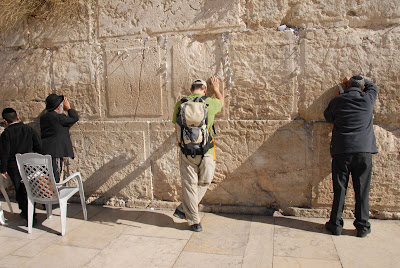
I think my pastor and I could both agree that the whole area seems to be under the sway of an odd mix of sin and holiness. It’s as if life is lived at a different intensity in the holy land: as if spiritual forces are more actively engaged. The first time I touched the Wall, I felt a sudden weight of centuries, of depth, of history, of glory: the legacy of David. The second time I touched it, I felt a sense of waiting, expectation, sadness, and more waiting: the legacy of Nathan.

Saturday, March 17, 2007

Atheists in the Holy Land

Over the last 9 months, my work has taken me fairly frequently to Israel. Zango -- the company I work for, and helped start back in 1999 -- has rented an apartment in downtown Tel Aviv, just off of Rabin Square, where I've stayed the last several visits. I walk a half-mile or so to the office every morning, and back in the evening, down Ibn Gvirol Avenue. Lots of folks have commented on how "Western" Tel Aviv feels, and they're onto something. My wife says that Tel Aviv reminds her of Sevilla, in Spain, and that sounds about right.
As secular as Tel Aviv can be, religion is never too far from the surface in the Holy Land. Only a few people in our office would describe themselves as "religious", but you scratch an Israeli, and he'll bleed religion, even if it's not the sort you'd expect. At a company lunch the other day, the topic of God came up. My curiosity got the better of my judgment, and I asked the general question, "OK, who here believes in God?" Of the eight folks around the table (all Jews except for me), six of them professed a belief in God of some sort, andtwo denied His existence outright. Israelis being Israelis -- which is to say, in favor of argument of every sort, and in that way much like me -- this prompted an extended argument that lasted well after we had left the restaurant.
If my limited experience is any guide, that ratio -- 25% atheists -- seems to be reasonably representative of the larger population. My good friend Rinat varies between disliking God intensely and merely disbelieving in His existence, but usually professes the latter. My friend Meir is as loud and vocal about his atheism as about his poker playing, which is to say, quite passionate.
On a side note, I had the wonderfully surreal experience the other day of a long car ride with Meir and his best friend Moris. Moris made the mistake of acknowledging a belief in God, which earned a great deal of scorn from the loud and passionate Meir. The highlight of their argument, which lasted for many miles, was Meir's loud insistence to Moris that Christians didn't believe in the 10 commandments, an opinion which the repeated denials of the one Christian in the car (with an M.A. in theology, no less) did little to shake.
The paradox of atheists in an avowedly Jewish and religious country was made perhaps a bit more understandable to me after a visit to Yad Vashem. It's admittedly hard to believe in the goodness of a God who has supposedly chosen your people, after you've watched this same God allow your people to be "led like lambs to the slaughter". Even the name "holocaust", with its evocation of the Torah's "whole burnt offering", is an unsettling reminder of the paradoxes inherent in modern Judaism.
One image from Yad Vashem sticks with me beyond all others, however. When you finish your journey through the exhibits, the exit from the museum opens up almost trumpet-like, with an unparalleled view of the green hills of Jerusalem. The impact of this not-so-subtle architectural effect was not lost on me: after the Holocaust, Israel; after childbirth, a child. I don't claim to know what God is doing with the Jews or with Israel. St. Paul was content to call it a mystery, and I am too. But St. Paul was also convinced that God wasn't through with His people; and having spent some time in the Holy Land recently, I'm pretty well convinced of it as well.