Tuesday, August 19, 2008

Hauerwas’ Theory of Interfaith Dialogue

I'm reading through Stanley Hauerwas' The State of the University. On pp. 58-59, he retells an encounter with a process theologian in Arkansas who was unimpressed with Hauerwas' stress on Christian particularism. The process theologian observed that Hauerwas had no theory that would enable Christians to talk with Buddhists. Hauerwas responded:

I, however, apologized for being deficient of such theory, but asked, "How many Buddhists do you have here in Conway? Moreover, if you want to talk with them what good will a theory do you? I assume that if you want to talk with Buddhists, you would just go talk with them. You might begin by asking, for example, 'What in the world are you guys doing in Conway?'" I then suggested I suspected that the real challenge in Conway was not talking with Buddhists, but trying to talk with Christian fundamentalists. We should also ask whether we have anything interesting enough the Buddhist would even want to talk about with us.

This is a great example of the refreshing humor I'm beginning to find in Hauerwas, but he also makes a great point. It's less important to have a theory about how interfaith dialog can happen than to just go talk to each other. Hauerwas is very clear that this does not mean giving up on one's Christian (or Buddhist) beliefs, nor does it mean that we must engage in the sort of sloppy thinking that leads to proclamations like, "All roads lead to God." And it certainly doesn't mean that we don't try to convince the other person of the correctness of our views. It just means that we should talk, talk hospitably and respectfully, and that worry about the theory is a secondary concern.

Friday, August 15, 2008

Genetic Engineering and our Dependence on Technology

I haven't done enough reading in the ethics of genetic engineering to have any real sense for the issues that are being discussed in that field. But I've been thinking this thought for a while, and I've never actually heard it addressed, so I thought I'd toss it out.

One of the things that people worry about with human genetic engineering is that we'll be mucking with our gene pool in artificial ways, a prospect most people find unsettling for reasons that aren't generally specified, and perhaps aren't specifiable.

I don't know what the right answer here is, but one thing that should be noted in any discussion of human genetic engineering is that we're already mucking about with our gene pool in ways that are obvious once they're pointed out. The 20th century advances in medical technology have allowed lots of people to survive who would previously have been weeded out of the gene pool.

Lest I appear hard-hearted, let me hasten to point out that I'm one of these: I've had trouble with my ears all my life, I've had numerous surgeries to (partially) correct these problems, and I've been told by various doctors that were it not for these surgeries, it's quite likely that the mastoiditis which has given me such trouble would have eventually spread to my brain. In addition, I have a susceptibility to strep throat that, were it not for modern antibiotics, would probably have had me pushing up daisies some years ago. I'm very grateful that I'm not now six feet under, but from a genetic, evolutionary perspective, folks like me are precisely the problem. A hundred years ago, a set of genes like mine would have died out before they could get passed on, with the result that the next generation wouldn't have to put up with these problems. But these days, because of our dependence on technology, problematic genes are getting passed on routinely, ensuring that the next generation will be even more dependent on technology than we are today.

I should note that this particular tendency has been observed in other settings. According to Fred Lanting, wild dingoes are almost completely free of hip dysplasia: natural selection ensures that this particular trait doesn't get passed down. But a colony of wild dingoes bred in captivity for 40 or so years (without the pressure of natural selection) showed that a "substantial portion" of the captive dingoes suffered from hip dysplasia. I can't think of any reason why the same thing isn't happening to human beings.

I can't swear that this analysis is correct, though it makes sense to me. I don't know how quickly our gene pool is degrading, but it seems likely that it is in fact doing so, and that it's just a matter of time before the vast majority of human beings will be all but incapable of surviving without significant technical assistance. Entropy always tends to increase, Newton said, and without the pressure of natural selection, the entropy inherent in the human gene pool will increase more quickly than we expect.

Assuming for the moment that this is accurate, what are our options here? None of them sound particularly appealing, but for very different reasons.

  1. We can continue down the current path, letting the human gene pool deteriorate, constantly supplementing its decline with increasingly sophisticated "external" technologies (such as surgery, antibiotics, artificial limbs and organs). In a dozen or so generations, the human race would be nearly cyborg in reality, if not appearance.
  2. We can address the problems in our gene pool by letting survival of the fittest take its course. This isn't really even thinkable, of course: if we can help someone with medical problems, we're morally obligated to do so.
  3. We can address the problems in our gene pool through genetic engineering. Presumably this wouldn't be through "eugenics", but through appropriately targeted gene therapies. The practical problems are many, of course: we don't have words to describe just how complex the human genome really is. We're at least decades and maybe even centuries away from being able to diagnose and fix the sort of "minor" genetic problems that I suffer from, let alone the sort of body sculpting you read about in science fiction novels. But there is at least one theoretical advantage: once we fix a particular problem, it will more-or-less stay fixed: the fixed genes will automatically get passed on to the next generation. If we ever get the technology figured out, we could presumably fix the decline of the human genome.

Not many folks are really passionate advocates of this last approach: human genetic engineering is a technology perched atop a rather slippery slope. It's not real likely that we'd be able to stop with "fixing the decline": as Ellul pointed out, technology that can be used almost certainly will be used. If we have the ability to give our children (never mind ourselves) super-human intelligence, super-human strength, or greatly extended lifespans, I think we certainly will.

But even if you don't buy the idea of a normative human nature (which I think I do), nobody really likes the idea of their genetic makeup being deliberately and specifically programmed by someone else. Written well before genetic engineering became a possibility, I think C. S. Lewis' Abolition of Man is nevertheless a fairly accurate prophecy of what will happen if we aren't very careful with these technologies. If we can meddle with our descendants' intelligence, will we also choose to meddle with their sense of morality? On what basis would we do so if we're convinced that morality is just a combination of social and evolutionary pressures? From this perspective, what would constitute a better or worse morality, and on what basis would we decide?

"If any one age really attains, by eugenics and scientific education, the power to make its descendants what it pleases, all men who live after it are the patients of that power. They are weaker, not stronger: for though we may have put wonderful machines in their hands we have preordained how they are to use them… The last men, far from being the heirs of power, will be of all men most subject to the dead hand of the great planners and conditioners and will themselves exercise least power upon the future…. Man's conquest of Nature, if the dreams of some scientific planners are realized, means the rule of a few hundreds of men over billions upon billions of men." (The Abolition of Man, pp. 68-69)

But as morally ambiguous as the third option is, I know of even fewer people who would be advocates of the first or second.

I'm not here trying to decide which of these approaches is the right one. I don't like any of them. But if I have any contribution to make to the argument, it would be to point out that the debate isn't about "genetic engineering" in the abstract. It's a choice between various unpalatable options: we have to pick one of these three. There is no neutral choice.

Thursday, August 14, 2008

Backpacking at Dorothy Lake

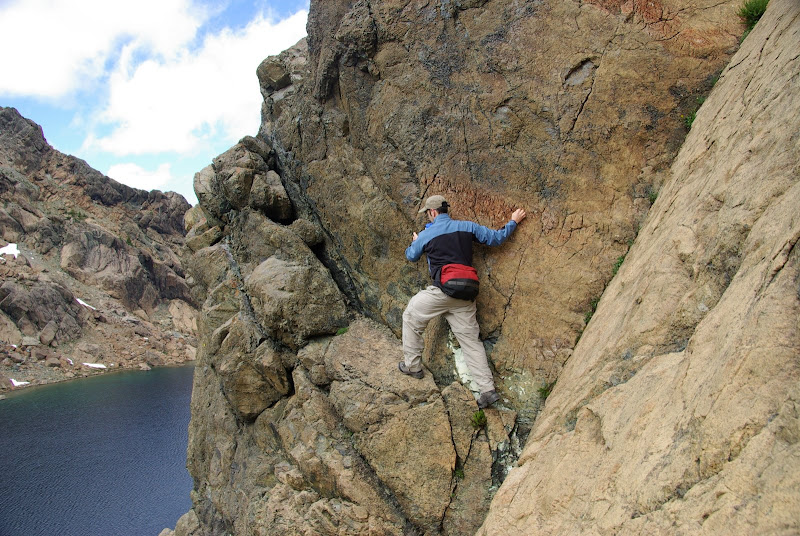
For my Dad's birthday in July, I offered to take him on a backpacking/photography trip to a location of his choice. We ended up going to Dorothy Lake and environs, and spent a couple days hiking around, taking pictures, cooking steak and bacon. I haven't seen my Dad's pictures yet, but a selection of mine follow.


More here.

Thursday, August 7, 2008

A Few More Thoughts on Exclusion and Embrace

I just finished Miroslav Volf's book Exclusion and Embrace, and on the whole, I was favorably impressed. There's a tremendous wisdom in Volf's writings: he's balanced and reasonable, widely read and explicitly Christian and orthodox. A couple very random notes on the book follow.

First, Volf certainly constructs a theology: he doesn't take the older (Protestant) view that a theology is to be discovered by comparing and contrasting the relevant Biblical texts. He certainly takes the Bible seriously, though his use of Biblical texts is creative and suggestive as well as exegetical. He doesn't so much seek to discover a theology as to create one: thoughtfully, prayerfully, with wisdom and an eye towards the Christian tradition, with a sense of how it must be used in both Christian and non-Christian frameworks, but he's nevertheless still building, and just as there is more than one way to architect a building (or a computer program), so he would presumably acknowledge that there is more than one way to construct a valid theology. (Of course, just because there is more than one way to construct something doesn't mean that every way of constructing it is legitimate.)

Second, one of the things that most impressed me about the book was the thoughtful and creative way that he engaged thinkers with whom he fundamentally disagreed. It was striking, for instance, just how often he quoted Nietzsche: some 25 or more times, if the book's index is accurate. Although Nietzsche and Volf could not be further apart in either method or worldview, Volf manages to do more than just quote Nietzsche to disagree with him. In almost every instance, he finds something to affirm about Nietzsche, some aspect of what he's saying that is true, or at least points towards the truth. I noticed Volf's frequent references to Nietzsche right away, but it took me almost halfway through the book to realize what he was doing. The point of Volf's book, of course, is that we must make space within ourselves even for our enemies, that we must will to embrace our opponents, even evil-doers, before justice can be truly served. In dealing with Nietzsche, Volf does a remarkable job of modeling just how that process can work.

And finally, as you would expect from anyone who has an interest in issues of oppression, Volf is a convinced though not a radical feminist. He makes the common claim (denied by folks like C. S. Lewis) that there is nothing of gender in God, and he moves beyond this to say that we can learn nothing about gender roles from observing the Trinity at work. Disagreeing with Karl Barth, who argued that human males image the maleness in God, Volf writes:

All specifically masculine or feminine content of the language about God stems exclusively from the creaturely realm... We can find in our notions of God only those things about femininity or masculinity that we ourselves have placed into these notions. Since God is beyond sexual difference, there is nothing in God that can correspond to the specifically fatherly relation that a man has toward his progeny. A human father can in no way read of his responsibilities as a father from God the Father... Whether we use masculine or feminine metaphors for God, God models our common humanity, not our gender specificity... Again, God does not model gender identity. (pp. 170-172)

At first I thought Volf was denying the analogia entis (a fairly common thing to do these days), but as I thought more about it, I don't think he was: he's just denying that gender is a part of it. And as to whether we can learn anything about gender roles by observing God, I was really only able to come up with one clear Scriptural counter-example. Paul is very clear that we can learn about what it means specifically to be a husband or specifically to be a wife by observing Christ's relationship to the Church, His bride:

Wives, submit to your husbands as to the Lord. For the husband is the head of the wife as Christ is the head of the church, his body, of which he is the Savior. Now as the church submits to Christ, so also wives should submit to their husbands in everything.  Husbands, love your wives, just as Christ loved the church and gave himself up for her to make her holy, cleansing her by the washing with water through the word, and to present her to himself as a radiant church, without stain or wrinkle or any other blemish, but holy and blameless. (Ephesians 5:22-27)

A second possible counter-example might be Ephesians 3:14-15:

For this reason, I bow my knee before the Father of our Lord Jesus Christ, from whom all fatherhood in heaven and on earth is named.

This is at least one possible translation of it, and if accurate, it would imply that human fatherhood is a shadow or a reflection of God's divine fatherhood, with echoes of neo-Platonism. But you could also render "εξ ου πασα πατρια ονομαζεται" as "from whom his whole family derives its name" (as the NIV does), and that takes some of the force out of my argument.

Caedmon’s Dinner Redux

Caedmon – our personal hobbit – was having an odd day today. He ate hardly any "second breakfast", and refused to eat any lunch. He ate a normal amount for "second lunch", but when dinner came around he was famished. He ate two slices of cheese, half a hot-dog, and then three bowls of blueberries.

After dinner he took a bath, and then had his standard bedtime bottle, which he drank completely.

I was cuddling with him for a few minutes before putting him down when I noticed he was, well, hiccuping, or something like that. That went on for 15-20 seconds.

Then it all came back, like a bad debt.

The first wave of formula, blueberries and hotdog washed all over my shirt, shorts and the chair.

Caedmon turned to look at me, astonished.

The second wave exploded directly onto my face.

I hurriedly moved him out to arms length.

The third wave drenched my arms, his sleep sack and the carpet.

Poor Caedmon dangled for a few seconds, as stunned as I was, then started to cry.

Sigh.

I comforted the poor guy, then dropped him off in the bathroom, stripped down to my shorts, and proceeded to clean up. A new onesie for the over-eager hobbit, some quick cleanup of the larger pieces, and Caedmon back in bed, I was finally able to take a shower. But I'm not sure the smell or Daddy's trauma will be leaving anytime soon.

Wednesday, August 6, 2008

Thinking about God in an Age of Technology

I'm working my way through George Pattison's book Thinking About God in an Age of Technology. Apart from his strange fascination with radical theologies (a fascination for which I have very little sympathy), I'm finding it helpful. If nothing else, I'm taking note of the thinkers and theologians with whom he's interacting: it's a reasonably good start at a map of the various theologies of technology that have been proposed. Not surprisingly, there's more there than I realized. That's good, as I'm hoping to do a dissertation on the topic at some point, and I was hoping that the ground wouldn't be entirely unplowed. Still, it seems like there's a fair bit of work remaining to do on this topic.

I may have more to post on Pattison's book later, but I'll leave it now with an interesting note. On pp. 51-56, he offers his criticisms of Ellul's critique of technology, and Pattison's criticisms can be reduced to saying, "It isn't all that helpful."

Can Ellul offer more on the plane of human action and value than a kind of negative dialectic, a critique of the present in the name of an impossible and humanly unattainable freedom? If technology is charged with a totalizing tendency that sucks all phenomena into its infernal machinery, is this not a projection of Ellul's own Barthian method, namely, the reduction of the phenomena in their entirety to a single category (in this case 'technology') that is then used as a name for the kingdom of this world, for everything that is not and is intrinsically and essentially opposed to the Kingdom of God? Is there anything here one could lay hold of as a concrete strategy of resistance of transformation?

Now, I have to agree with him that this is a weakness of Ellul, or at least, of the very little bit of Ellul that I've read. But I find it curious that Pattison doesn't seem nearly as interested in attempting to understand whether Ellul's critique of technology (never mind its theological or practical ramifications) is true. For what seemed to me obvious reasons, the questions that struck me as I was reading Ellul centered on whether his critique was accurate. Does technology actually have the absolutist tendencies that he claims? Will it really "suck all phenomena into its infernal machinery"? Is there really so little hope that we can escape its power? And of course, the answer I came up with (here, here, here and here) is, "I don't think so, for the following reasons". But Pattison seems more interested in how Ellul can be used than in whether Ellul is right.

I only noticed this about Pattison's treatment of Ellul because I had recently been engaged in a similar project: but it makes me wonder if a lot of academic writing suffers from precisely this lack of concern over the status of the truth-claims of the literature with which it's engaging. It certainly seems to me that a position should be dismissed because it's inaccurate and fails to correspond with the reality it's trying to describe, not because it's unhelpful. But perhaps I'm operating with an excessively naïve and optimistic epistemology.

Sunday, August 3, 2008

Ingalls Lake

Todd Keller and I spent a couple days this weekend up at Lake Ingalls, just north of Cle Elum. It was great weather for photography: enough clouds to even out the light, enough sunlight to make it interesting. On Saturday, we did a non-technical ascent of Ingalls Peak (~7600 feet), but mostly what I'll remember is the opportunity for pictures.


More here.